

From DFW’s record-breaking terminals to Austin’s tech-driven boom, here is exactly what the data shows about the luxury ground transportation revolution already reshaping Texas’s biggest airports.
If you have flown into a Texas airport lately, you have probably noticed something different at the curb: fewer crowded taxi lines, more sleek black SUVs, and more sharply dressed chauffeurs holding name cards. The premium car service boom is real, growing fast, and Texas is right at the center of it.
Since 2022, Texas has seen explosive passenger growth across its major airports, and that surge has not just benefited airlines. It has created a wave of demand for luxury ground transportation, executive car service, and high-end airport transfers that shows no signs of slowing down. Whether you are a business traveler flying into DFW, a tech executive landing at Austin-Bergstrom, or an international visitor touching down in Houston, the way people move after landing has quietly gotten a whole lot more premium.
The Big Picture Behind the Boom
Texas is not just big in size; it is big in air traffic. According to the Texas Economic Development Corporation, the state has nearly 400 airports, including 24 commercial service airports, with civil aviation contributing more than $110 billion to the Texas economy and supporting nearly 644,000 jobs. That is an enormous foundation for any industry connected to air travel.
Passenger numbers have been staggering since the post-pandemic recovery. The U.S. Travel Association reports that domestic travel spending surpassed pre-pandemic levels in 2023, and Texas, sitting at the crossroads of domestic and international routes, benefited enormously from that rebound.
The result? More people are flying in and out of Texas airports than ever before, and a growing number of those travelers are demanding something better than a rideshare surge price or an unpredictable taxi.
“The global private chauffeur service market was valued at an estimated $54.2 billion in 2023 and is projected to reach $188.9 billion by 2033, growing at a CAGR of 13.3%.”
— Global Market Insights, 2024
North America dominates this market with a 39.1% share, and Texas airports are riding right at the top of that wave.
Texas major airport passenger traffic, 2022 to 2024
| Airport | 2022 Passengers | 2023 Passengers | 2024 Passengers |
|---|---|---|---|
| Dallas–Fort Worth (DFW) | 73.4 million | 81.8 million | 87.8 million |
| Houston IAH + HOU | ~57 million | 60.1 million | 63.1 million |
| Austin-Bergstrom (AUS) | ~21 million | 22.1 million | 21.8 million |
| San Antonio (SAT) | Growing | Growing | Growing steadily |
Dallas–Fort Worth International (DFW) — the undisputed leader
When it comes to executive car service demand at Texas airports, no airport comes close to DFW. According to DFW International Airport’s 2024 Annual Report, the airport welcomed 87.8 million passengers in 2024, a 7.4% increase from 2023 and the highest passenger traffic in the airport’s history.
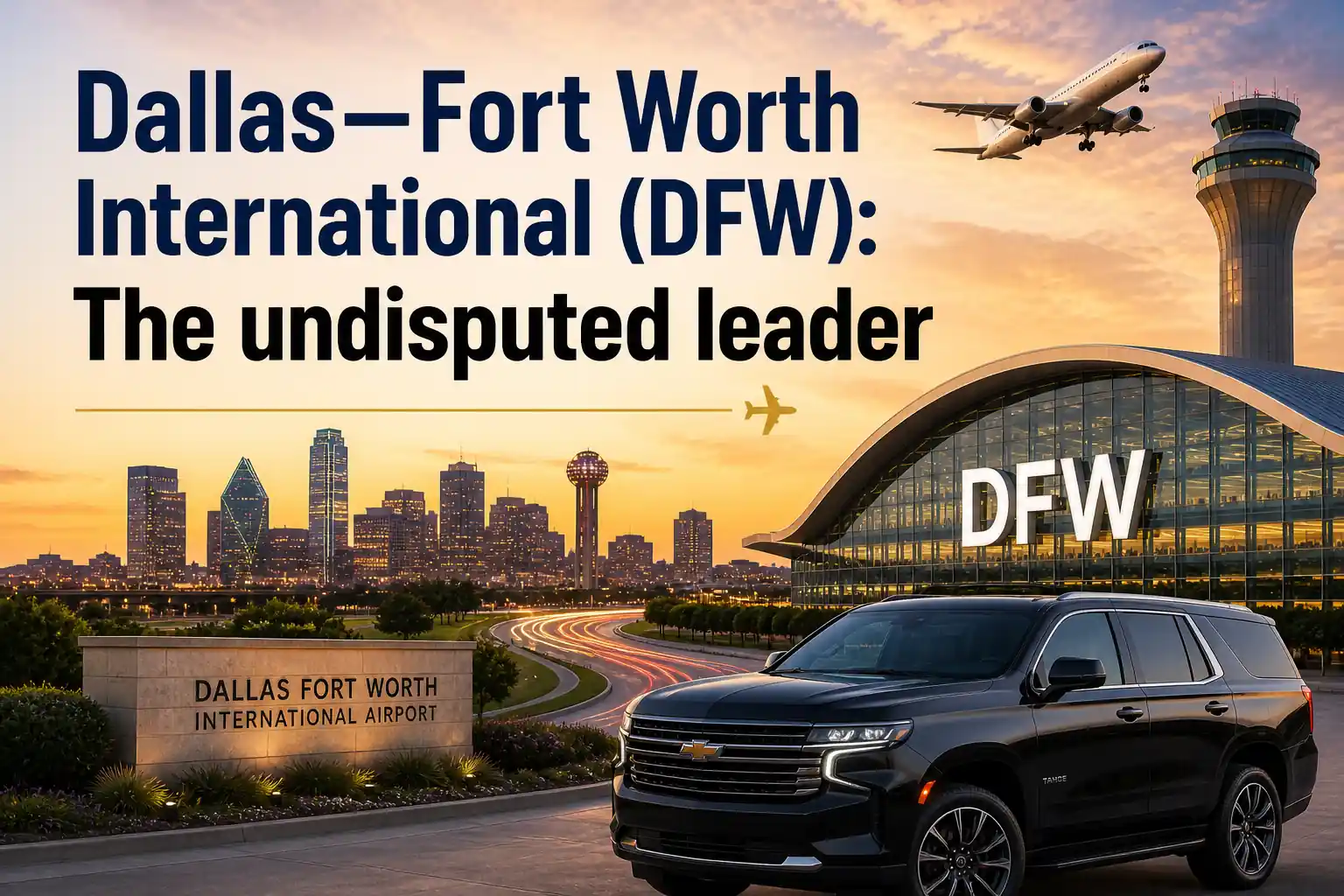
DFW ranks third globally in aircraft operations, with DFW Airport Operations recording over 743,000 take-offs and landings in 2024. As of April 2023, DFW also offers service to more nonstop destinations than any other airport in North America, covering 196 domestic and 73 international routes, per American Airlines route network filings. Every one of those routes brings in potential clients for luxury transportation providers.
Business travelers flying in for corporate meetings, executives arriving for conferences, and high-net-worth individuals heading to luxury hotels all expect a certain standard of ground transportation. IBISWorld’s Luxury Car Service Industry Report (2024) notes that as corporations grow, so does the demand for luxury sedans and black cars over taxis, and DFW, with its deep roots as a corporate hub, is a textbook example of that dynamic.
DFW is projected to handle nearly 7.98 million passengers during the 2025 holiday travel season, a figure about 40% higher than the five-year average, according to the DFW Airport Authority’s holiday forecast released in October 2025. Despite a modest mid-year dip, DFW still ranked as the third most popular airport destination in the entire country, recording over 13.8 million arrivals between January and May 2025.
DFW is also undergoing a major expansion. In May 2025, DFW and American Airlines jointly announced an expanded $4 billion plan for the new Terminal F, increasing it to 31 gates with full landside facilities. The first 15 gates are scheduled to open in 2027.
DFW Airport Growth Timeline
| Year | Passengers | Notes |
|---|---|---|
| 2019 | 75.1 million | Pre-pandemic peak |
| 2020 | 39.4 million | Pandemic impact |
| 2021 | 62.5 million | Recovery begins |
| 2022 | 73.4 million | Near pre-pandemic levels |
| 2023 | 81.8 million | Surpasses pre-pandemic record |
| 2024 | 87.8 million | All-time record high |
| 2025 (holiday projection) | 7.98 million (Nov–Dec only) | 40% above 5-year average |
Houston Airports (IAH and HOU): A two-airport powerhouse

Houston is the only major Texas city operating two significant commercial airports, and both are contributing to the premium transportation boom. According to the Houston Airport System Economic Impact Study (2024), George Bush Intercontinental (IAH) and William P. Hobby (HOU) together surpassed 63.1 million travelers in 2024, 3 million more than in 2023, and the two airports combined generated an estimated $40.6 billion for the regional economy.
IAH serves as the primary hub for United Airlines and connects Houston to major international business destinations across Latin America, Europe, and Asia. The passenger mix leans heavily toward corporate travelers, energy-sector executives, and international business visitors, a demographic very comfortable spending on executive transportation and professional chauffeur service.
HOU has become increasingly popular for domestic business and leisure travel, particularly since Southwest Airlines made it a major operating base. Many Houston executives specifically prefer Hobby for its more manageable layout, and luxury car service providers have responded by deploying dedicated fleets to both airports with real-time flight tracking and meet-and-greet capabilities.
Per the Federal Aviation Administration’s ASPM database (mid-2025), Houston’s William P. Hobby Airport saw a 7.1% decline in passenger arrivals in the first seven months of 2025. However, IAH is projected to see a 43% increase in holiday season travelers in late 2025, with an estimated 4.58 million passengers expected in November and December alone.
Houston airport passenger comparison, Jan–Jul 2024 vs 2025
| Airport | Jan–Jul 2024 | Jan–Jul 2025 | Change |
|---|---|---|---|
| William P. Hobby (HOU) | 4,263,472 | 3,962,498 | ▼ Down 7.1% |
| George Bush Intercontinental (IAH) | Strong growth | Holiday projection: 4.58M (Nov–Dec) | ▲ Up 43% projected |
Austin-Bergstrom International (AUS): The fastest-rising star
If DFW is the heavyweight and Houston is the steady giant, Austin-Bergstrom is the rapidly growing contender no one can afford to ignore. According to Austin-Bergstrom International Airport’s official passenger statistics, AUS set a record in 2023 with 22,095,876 total passengers, more than 1 million ahead of the previous record set in 2022. In 2024, the airport handled 21.8 million passengers, still the second-busiest year in AUS history.

In October 2025, AUS broke a new single-month record with 2,086,037 passengers, driven in part by the Formula 1 weekend at Circuit of the Americas. A single Monday after the F1 race saw over 45,000 passengers screened by TSA in one day, the busiest single day in the airport’s history.
But raw passenger numbers do not tell the whole story about Austin. The type of traveler landing at AUS has changed dramatically since 2022. Austin has become one of America’s premier tech and innovation hubs, attracting major corporate campuses from Tesla, Apple, Oracle, and Dell, per the Austin Chamber of Commerce’s 2024 Business Climate Report. The passengers arriving at AUS increasingly include high-earning tech executives, venture capitalists, startup founders, and international business visitors, all people very accustomed to booking professional car service.
According to AUS Airport Authority holiday travel projections (2025), Austin-Bergstrom is expected to see passenger traffic nearly 56% above its five-year average, with over 2.27 million travelers projected in November and December 2025. Multiple airlines, including Southwest, Delta, and Frontier, launched new nonstop routes from Austin in 2025, expanding AUS connectivity to cities like San Francisco, New Orleans, Vancouver, and Jacksonville.
Austin-Bergstrom Passenger Milestones
| Period | Passengers | Significance |
|---|---|---|
| 2022 | ~21 million | Previous record at the time |
| 2023 | 22.1 million | All-time annual record |
| 2024 | 21.8 million | Second-busiest year ever |
| Oct 2025 | 2,086,037 | New single-month record |
| Nov–Dec 2025 (projected) | 2.27 million+ | 56% above 5-year average |
Austin’s airport is also undergoing its largest expansion program in history, called Journey With AUS, which includes a new Concourse B with 20+ gates, an expanded terminal, a new centralized TSA checkpoint, and improved roadways. Per Austin-Bergstrom Airport officials quoted in the Austin American-Statesman, passenger growth is hitting forecasts five years ahead of schedule.
San Antonio International (SAT): The quiet contender
San Antonio often gets overlooked in conversations about Texas airports, but it is quietly growing its premium transportation market. According to San Antonio International Airport‘s 2024 Cargo & Operations Report, SAT handled about 238 million pounds of cargo in 2024, and its passenger base has grown consistently alongside the city’s expanding corporate sector and tourism appeal.
San Antonio is home to major military installations, a strong healthcare and biomedical industry, and a growing tech scene. These sectors generate steady demand for executive car service, particularly for client visits, hospital board meetings, and medical conference transportation. The city’s tourism appeal around the Riverwalk, historic missions, and major conventions at the Henry B. Gonzalez Convention Center also draws a large segment of leisure travelers who appreciate the reliability of a pre-booked luxury transfer.
What is driving the premium car service boom specifically?
The passenger growth at Texas airports explains the demand opportunity, but it does not fully explain why premium car service in particular has boomed since 2022. There are several key forces at work.
Corporate travel rebounded and upgraded. After two years of virtual meetings and Zoom calls, corporate travel came back stronger than expected post-pandemic, but it came back with higher expectations. According to Grand View Research’s Chauffeur Market Segmentation Report (2024), corporate clients now account for 52.3% of the global chauffeur service market, the largest single segment.
Surge pricing fatigue is real. Anyone who has tried to grab a rideshare from DFW or IAH during peak hours knows the pain of surge pricing. Prices that triple during busy periods, long wait times, and unpredictable driver quality have pushed a meaningful number of travelers, especially frequent business flyers, toward the fixed-rate, predictable world of black car service.
Texas is growing fast and attracting wealth. Per the Texas Office of the State Demographer’s 2024 Projections Report, Texas’s population may double by 2050, reaching more than 54 million residents. That growth is being led by high-income migrants from California, New York, and other expensive states, people who already have a habit of using luxury transportation services.
App-based booking made premium accessible. According to Statista’s 2024 U.S. Car Rental and Chauffeur Market Report, online booking channels accounted for 70.1% of the U.S. car rental and chauffeur market in 2024. The ability to book in advance with transparent flat-rate pricing, vehicle selection, and real-time tracking has made executive car service accessible to a much broader audience than ever before.
Rideshare vs Premium Transportation at Texas Airports
| Feature | Rideshare App | Premium Transportation |
|---|---|---|
| Flight tracking | No | Yes — real-time monitoring |
| Meet and greet at the gate | No | Yes — professional greeter |
| Fixed pricing | No (surge pricing) | Yes — flat-rate quotes |
| Professional chauffeur | No guarantee | Background-checked and trained |
| Vehicle quality | Variable | Luxury fleet, always clean |
| Corporate invoicing | Limited | Full corporate accounts available |
What to look for in a premium car service at a Texas airport?
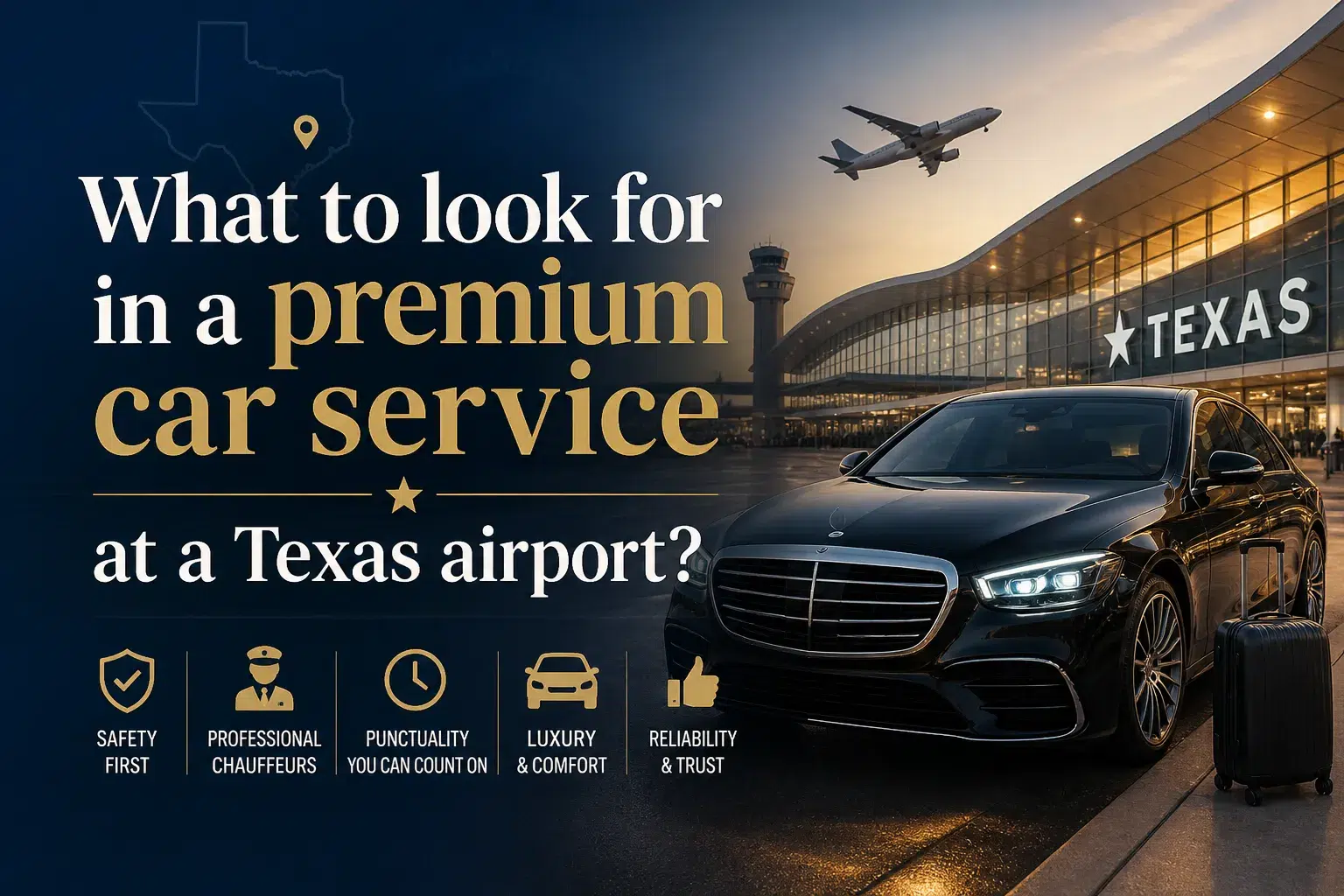
- Flight tracking is non-negotiable. A quality luxury car service monitors your flight in real time and adjusts your pickup time automatically if your flight is delayed or arrives early.
- Professional chauffeurs make all the difference. Look for services that perform thorough background checks on drivers, require professional training, and maintain consistent dress codes.
- Vehicle quality and variety matter. Whether you need an executive sedan for a solo business trip, a luxury SUV for a family arrival, or a Sprinter van for a corporate group, a reputable service should offer a clean, well-maintained fleet.
- Transparent flat-rate pricing is a hallmark of quality. You should know your price before you book, not after you arrive. No surge pricing, no hidden fees, no surprises.
- Corporate accounts add serious value. For corporate travelers, the ability to set up accounts with invoicing, expense reporting integration, and consistent service quality is a significant advantage over rideshare apps.
The Road Ahead: Texas premium transportation in 2025 and beyond

The signs all point to continued growth. DFW is expanding with a massive new terminal planned to open in phases from 2027 onward. Austin is investing in its largest infrastructure program in history. Houston is celebrating record passenger milestones year after year. San Antonio continues its steady climb.
While 2025 brought a slight mid-year dip in passenger traffic across some Texas airports, partly influenced by broader softening in U.S. travel demand and some international route adjustments, the holiday season data confirms that Texas airports remain among the most active in the country.
For travelers who fly regularly into Texas, the calculus is simple. More airports. More flights. More passengers are competing for the same curbside pickup spots. The value of a pre-booked, professional luxury car service — where a chauffeur is already waiting, tracking your flight, ready to handle your luggage — is only going to grow.
FAQs: Which Texas Airports Are Powering the Premium Car Service Surge (2022–2026) and Shaping the Future?
Q: What is a premium car service at an airport?
It is a pre-booked luxury vehicle with a trained, background-checked chauffeur offering fixed pricing, flight tracking, and guaranteed quality, unlike rideshares, which use variable surge pricing and unverified drivers.
Q: Which Texas airport has the most demand for luxury car service?
Dallas–Fort Worth (DFW) leads with a record 87.8 million passengers in 2024 and the highest concentration of corporate and Fortune 500 travelers in Texas.
Q: Is an executive car service more expensive than standard on-demand transportation?
Slightly but flat-rate pricing often beats surge pricing at peak hours. Most business travelers find the reliability and comfort well worth the difference.
Q: How do I book a premium transportation at Austin-Bergstrom Airport?
Book online, enter your flight details, pick your vehicle, and get a fixed quote upfront. Reserve at least 24 hours ahead, especially during SXSW or the F1 weekend.
Q: Are executive car services available for group travel?
Yes. Sprinter vans, minibusses, and motor coaches are available at DFW, IAH, AUS, and SAT for corporate groups, wedding parties, sports teams, and large families.